Cabbagetown's story begins not with a planner's vision or a developer's profit motive, but with a factory and the people who worked in it. For nearly a century, this tiny patch of land south of downtown Atlanta was a self-contained mill village — a place where your neighbors were your coworkers, your church was down the street, and your entire life revolved around the rhythms of the Fulton Bag and Cotton Mill. Understanding that history is the key to understanding why Cabbagetown feels the way it does today.
The Mill and the Village (1880s–1920s)
In the early 1880s, Jacob Elsas, a German-Jewish immigrant and industrialist, built the Fulton Bag and Cotton Mill on the east side of Atlanta. The mill processed cotton into bags and textiles, and it quickly became one of the city's major employers. Elsas needed housing for his workers, so he built a village of small, inexpensive homes on the surrounding land — rows of tiny frame cottages and shotgun houses arranged on narrow streets, all within walking distance of the mill gates.
The village was paternalistic by design. Elsas and the Fulton Bag company owned the homes, the general store, and much of the surrounding infrastructure. Workers rented their houses from the company, shopped at the company store, and attended churches that the company supported. It was a closed economic ecosystem — common in the American South and industrial North during this era.
The homes themselves were modest. Most were one-story frame structures — shotgun houses, folk Victorian cottages, and simple vernacular buildings — built on narrow lots with minimal setbacks from the street. There was no running water initially, no indoor plumbing, and no electricity. The houses were designed to be functional, not beautiful. But over time, the residents who lived in them made them their own — painting them in bright colors, planting gardens, and building the small, intimate streetscape that defines Cabbagetown today.
The Working-Class Years (1920s–1960s)
Through the early and mid-20th century, Cabbagetown was a working-class neighborhood in the truest sense. The mill ran three shifts. Families lived in the same houses for generations. The community was tight-knit — not by choice, necessarily, but by circumstance. When you live eight blocks from your job and your neighbors are the people you work beside every day, community isn't optional. It's survival.
The neighborhood was predominantly white during this period — a mix of Southern-born families and European immigrants who had come to work in the mill. The mill provided a measure of economic stability, even if it wasn't prosperity. Workers earned enough to raise families, but not enough to leave. Cabbagetown was home because it was home, and for decades, that was enough.
The mill began to decline in the 1950s and 1960s as textile manufacturing moved overseas and to the American South's rural areas, where labor was cheaper. The Fulton Bag and Cotton Mill, once a symbol of Atlanta's industrial ambition, was shrinking. And as the mill shrank, so did the village that surrounded it.
Decline and Discovery (1960s–1980s)
The Fulton Bag and Cotton Mill closed in 1977. With the mill gone, the economic foundation that had supported Cabbagetown for nearly a century disappeared overnight. Families who had lived in the neighborhood for generations moved away. Properties deteriorated. The city largely ignored the area. By the early 1980s, Cabbagetown was one of Atlanta's most neglected neighborhoods — a collection of aging cottages with peeling paint, sagging porches, and uncertain futures.
But something unexpected was happening. Artists, musicians, and young people who couldn't afford housing elsewhere began discovering Cabbagetown. The rents were cheap. The houses, though worn, had character. The location — close to downtown, near the rail lines, adjacent to other historic neighborhoods — was surprisingly good. And the neighborhood's isolation, which had been a liability during the mill years, became an asset. Cabbagetown was off the beaten path, unregulated, and overlooked — the perfect conditions for an artist colony.
One of the most important figures in this transformation was Panorama Ray, a local photographer and character who helped draw creative people to the neighborhood. The artist migration wasn't planned or organized — it was organic, driven by economics and curiosity. But by the mid-1980s, Cabbagetown had a reputation as Atlanta's bohemian enclave, a place where you could live cheaply, make art, and be left alone.
Preservation and the National Register (1976)
Even before the mill closed, Cabbagetown had attracted the attention of preservationists. In 1976, the Cabbagetown Historic District was listed on the National Register of Historic Places — one of the earliest historic district designations in Atlanta. The listing recognized the neighborhood's architectural significance: its remarkably intact collection of late 19th-century and early 20th-century worker housing, including some of the finest shotgun houses in the Southeast.
The National Register designation didn't prevent all change — properties could still be modified or demolished by their owners — but it provided a framework for preservation and made it possible for owners to access tax credits for restoration. For a neighborhood that might otherwise have been demolished wholesale for parking lots or highway expansion, the designation was critical.
The Artist Era and Creative Culture (1980s–2000s)
The 1980s and 1990s were Cabbagetown's bohemian golden age. The neighborhood attracted a critical mass of artists, musicians, filmmakers, and creative misfits who transformed the former mill village into Atlanta's most unconventional community.
The Krog Street Tunnel — a pedestrian underpass connecting Cabbagetown to Inman Park — became an ever-changing canvas for graffiti and street art. The tunnel was never officially sanctioned for art, which is exactly why the art was good. Without curators or gatekeepers, the tunnel became a raw, democratic gallery where anyone could paint and the best work rose to the top.
Artists set up studios in their living rooms, garages, and basements. Musicians played in living rooms and small venues. The neighborhood had its own rhythm — late nights, morning coffee at Carroll Street Cafe, weekend porch gatherings. There was an anti-commercial, DIY ethos that defined Cabbagetown's identity. People made things — art, music, food, community — and they made them for each other, not for the market.
Carroll Street Cafe opened in the late 1990s and became the neighborhood's gathering place. French-inspired, unpretentious, and open to everyone, the cafe embodied Cabbagetown's character: small, warm, and deeply local. Little's Food Store, which had been serving the neighborhood since the 1920s, continued to anchor the community — a surviving link to the mill village era.
The BeltLine Era and Rising Interest (2010s–Present)
The opening of the Atlanta BeltLine Eastside Trail in 2012 changed the calculus for Cabbagetown — as it did for every neighborhood along the corridor. Suddenly, the area was connected to a regional trail system that attracted walkers, runners, cyclists, and tourists. Property values rose. Developers took notice. New construction appeared in adjacent neighborhoods, and the pressure to build — or sell — in Cabbagetown increased.
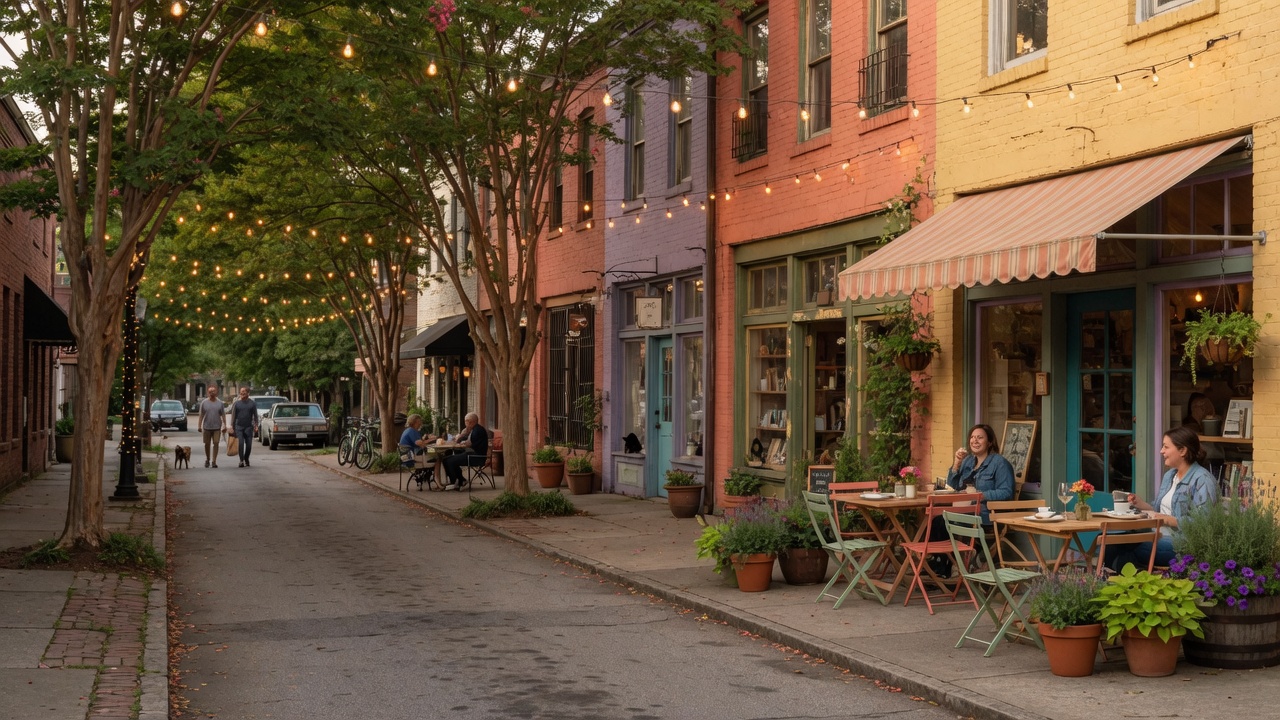
But Cabbagetown's small footprint and historic protections have limited the scale of new development within the neighborhood itself. Unlike Reynoldstown or Old Fourth Ward, where new townhomes and apartments have reshaped the landscape, Cabbagetown has largely retained its historic housing stock. The shotgun houses still stand. The bungalows are still painted in bright colors. The streets are still narrow and quiet.
What has changed is the price. As Cabbagetown's reputation has grown — and as Atlanta's intown housing market has tightened — homes in the neighborhood have become more expensive. The days of buying a shotgun house for $150,000 are long gone. But the neighborhood's character has survived the transition. The artists who could no longer afford to stay have been replaced by a new generation of residents who value what they found: authenticity, community, and a place unlike anywhere else in Atlanta.
Cabbagetown Today
Today, Cabbagetown is one of Atlanta's most desirable neighborhoods — small, walkable, and packed with character. The mill village that was built to house factory workers now attracts young professionals, artists, and families who want a neighborhood with real history and genuine community. The Krog Street Tunnel is one of Atlanta's most visited attractions. The Chomp and Stomp festival draws thousands every fall. And the colorful shotgun houses on Carroll Street remain one of the most photographed streetscapes in the city.
For potential residents, Cabbagetown offers something rare in Atlanta: a neighborhood that has been continuously shaped by the people who live in it, rather than by developers or city planners. That history — from mill workers to artists to today's community — is what gives Cabbagetown its soul. It's not just a neighborhood with nice houses. It's a place with a story, and the story is still being written.
About the Author

Tommy Williams
Tom Will Sell Atlanta · Intown Atlanta Expert
Tommy is passionate about Atlanta's neighborhood history and the stories that make each community unique. He's helped clients buy and sell homes throughout Cabbagetown and the east side, and he understands the context behind every block.