
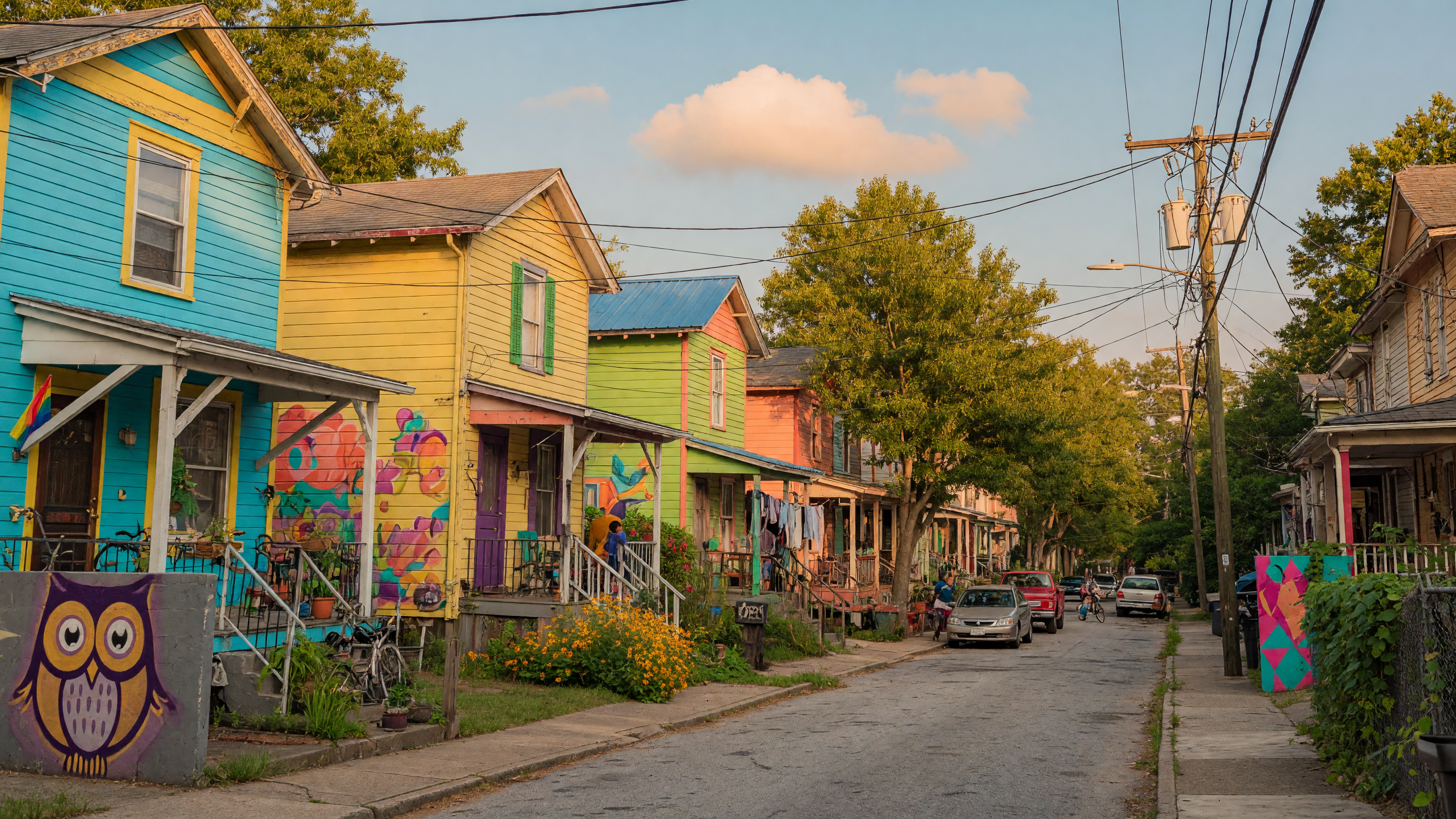
Buying or renting in Cabbagetown is different from buying anywhere else in Atlanta. The neighborhood is small — roughly eight blocks — with a limited number of homes that rarely come on the market. When they do, they move fast. The housing stock is historic, the lots are compact, and the prices reflect a neighborhood that has become one of Atlanta's most desirable places to live.
If you're considering Cabbagetown, here's what you need to know about the homes, the market, and what it actually takes to live here.
Housing Styles: What You'll Find
Cabbagetown's housing stock is remarkably consistent and historically intact. The neighborhood was built as a mill village in the 1880s and early 1900s, and most of the homes date from that era. Here's the breakdown:
Shotgun Houses
The signature home of Cabbagetown. These narrow, one-story frame houses were built for Fulton Bag and Cotton Mill workers — typically one to two bedrooms, 800 to 1,200 square feet, on lots that are 25 to 30 feet wide. Rooms are arranged one behind the other without a hallway, a practical design that maximized the use of narrow lots.
Many of Cabbagetown's shotgun houses have been lovingly restored with updated kitchens, bathrooms, and mechanical systems, while preserving original details like wood floors, beadboard walls, front porches, and transom windows. The best examples maintain their historic character while functioning as comfortable modern homes.
Price range: Renovated shotgun houses typically sell for $350,000–$500,000, depending on condition, size, and location within the neighborhood. Houses that need significant work occasionally appear at lower price points, but they're rare.
Bungalows and Cottages
Cabbagetown also has a collection of early 20th-century bungalows and folk Victorian cottages. These are slightly larger than the shotgun houses — typically two to three bedrooms, 1,000 to 1,500 square feet — with front porches, gabled roofs, and the Craftsman or Victorian details common to Atlanta's older neighborhoods.
Bungalows and cottages command a premium over shotgun houses, particularly when they've been fully renovated. Some of the best properties in the neighborhood are these larger homes with preserved historic details and modern updates.
Price range: Renovated bungalows and cottages typically sell for $400,000–$700,000, with premium properties exceeding that range.
Fulton Bag and Cotton Mill Lofts
The old mill building at the north end of the neighborhood has been converted into loft-style apartments and condominiums. These units offer industrial character — exposed brick, high ceilings, large windows — in a range of floor plans from studios to two-bedrooms.
Mill lofts are popular with young professionals and empty-nesters who want the Cabbagetown lifestyle without the maintenance responsibilities of a historic house. They offer the most accessible price point for owning in the neighborhood.
Price range: Lofts and condos typically sell for $343,000–$550,000, depending on size and finishes.
Modern Infill
Some new construction has appeared in and around Cabbagetown, typically as modern townhomes or single-family homes on infill lots. New development is limited by the neighborhood's small footprint, historic district protections, and the scarcity of available lots. When new homes do appear, they tend to be on the higher end of the price spectrum.
Price range: Modern infill homes typically start around $500,000 and can exceed $1 million for larger, custom-built properties.
Market Overview: 2025–2026
Cabbagetown's real estate market is defined by one thing above all else: limited inventory. The neighborhood is small — one of the smallest in Atlanta — and homes don't change hands often. When they do, competition can be fierce.
Here are the key numbers as of fall 2026:
Median sale price: Approximately $450,000–$550,000 across all home types, with significant variation by size and condition. Recent 2026 sales have run from the mid-$500,000s up past $800,000 for fully renovated properties, and the market still reads as competitive: homes that are priced right tend to go quickly.
Price range: From roughly $343,000 for small lofts to over $1.38 million for premium renovated properties.
Rental rates: Studios from approximately $1,650/month; one-bedrooms from $1,800/month; two-bedrooms from $2,000–$2,200/month.
Days on market: Well-priced homes in Cabbagetown tend to sell quickly — often within two weeks, and sometimes within days. Overpriced listings may linger, but the best properties generate immediate interest.
Walk Score: 83–90 out of 100, making Cabbagetown one of Atlanta's most walkable neighborhoods.
What Buyers Should Know
Buying in Cabbagetown requires some adjustments from the typical Atlanta home-buying experience:
Inventory Is Extremely Limited
Cabbagetown has roughly 300–400 residential properties. At any given time, only a handful may be for sale. Some years, very few homes change hands at all. If you're set on Cabbagetown, patience is essential — and so is having a responsive agent who knows the neighborhood and can alert you when something becomes available.
Homes Are Historic
Most Cabbagetown homes are 80 to 140 years old. That means character — but also potential issues. Before buying, get a thorough inspection. Pay attention to the roof, plumbing, electrical, foundation, and any signs of moisture. Many homes have been renovated, but the quality of renovations varies. Ask about the age and condition of major systems.
Historic District Protections
Cabbagetown is listed on the National Register of Historic Places, which means there are guidelines governing exterior changes. If you plan to renovate, add on, or make significant exterior modifications, you'll need to work within the historic district's guidelines. This isn't necessarily a burden — it's what protects the neighborhood's character — but it's something to understand before you buy.
Homes Are Small by Modern Standards
Cabbagetown's homes were built for mill workers, not for modern families with two cars and a home gym. Most are under 1,500 square feet. Many are under 1,000. Closets are small, storage is limited, and yards are compact. If you need a three-car garage and a home office for two, Cabbagetown may not be the right fit. If you value character and location over square footage, it might be perfect.
Parking Is Street-Only
Most Cabbagetown homes don't have driveways or garages. Parking is on the street, and while the neighborhood is quiet enough that this rarely feels like a problem, it's worth considering — especially if you have multiple vehicles.
What Renters Should Know
Renting in Cabbagetown is an option, though the rental market is small and competitive. Most rentals are in the mill lofts, in converted shotgun houses, or in a small number of multi-family properties. Studios start around $1,650/month, one-bedrooms around $1,800/month, and two-bedrooms from $2,000 to $2,200/month.
The rental market moves quickly. If you find a place you like, be prepared to apply immediately. Good Cabbagetown rentals don't stay on the market long.
Cabbagetown vs. Neighboring Areas
How does Cabbagetown compare to the neighborhoods around it?
Reynoldstown (to the north) offers similar housing styles — shotgun houses and bungalows — at somewhat lower price points, with more inventory and more new construction. Reynoldstown is larger and less constrained by historic protections, which means more options but a less defined neighborhood identity.
Grant Park (to the south) has larger Victorian and Craftsman homes on bigger lots, with higher price points and a more suburban feel. Grant Park offers more space and the Atlanta Zoo, but less of Cabbagetown's walkable, village-like character.
Inman Park (to the north via the BeltLine) is one of Atlanta's most prestigious intown neighborhoods, with grand Victorian mansions and Craftsman homes at significantly higher price points. Inman Park offers more dining and a more established commercial corridor, but at a premium.
For buyers who want the east side intown experience at a more accessible price point, with genuine history and a tight-knit community, Cabbagetown remains one of the best values in Atlanta — assuming you can find a home.
Tips for Buying or Renting in Cabbagetown
Work with a local agent. Cabbagetown is a neighborhood where relationships matter. An agent who knows the area — who knows which homes might be coming on the market before they're listed — is invaluable.
Be patient. Inventory is limited, and the right home may take time to appear. Don't settle for a property that doesn't fit your needs just because it's available.
Get a thorough inspection. Historic homes need careful evaluation. Don't skip this step, no matter how charming the house looks.
Think about your lifestyle. Cabbagetown works best for people who value walkability, community, and character over square footage and parking. If that's you, the neighborhood will feel like home from day one.
Visit before you decide. Walk through the neighborhood on a weekend morning. Sit on the Carroll Street Cafe patio. Talk to residents. Cabbagetown isn't for everyone — but for the people it's for, there's no place like it.
About the Author

Tommy Williams
Tom Will Sell Atlanta · Intown Atlanta Expert
Tommy has helped clients navigate the Cabbagetown market for years. With deep knowledge of the neighborhood's homes, history, and community, he can help you find the right property — whether you're buying, selling, or just exploring your options.