
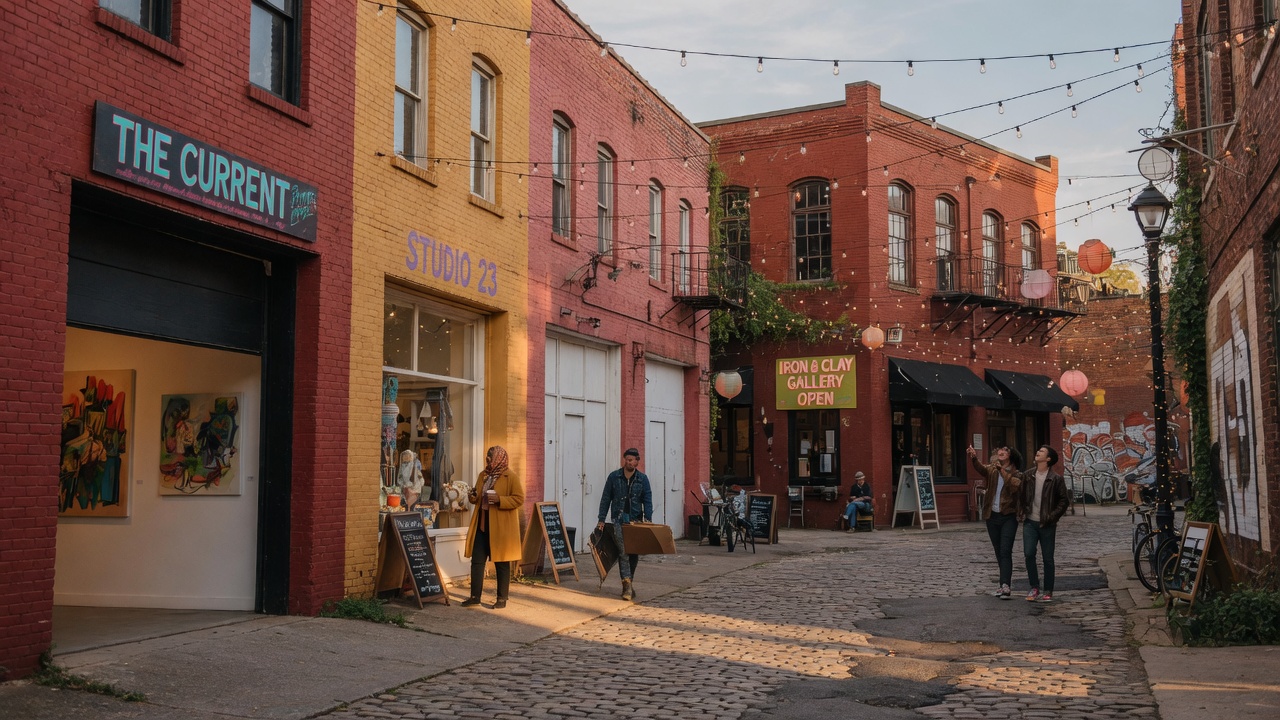
Castleberry Hill is Atlanta's original warehouse district — a compact, historic neighborhood just west of downtown where 19th-century brick warehouses have been reborn as loft apartments, artist studios, and some of the most character-rich homes in the city. If you've driven past Mercedes-Benz Stadium and noticed a cluster of old industrial buildings with cobblestone streets and gallery signs, you've seen Castleberry Hill.
It's not a neighborhood that shouts. There are no chain restaurants, no big-box stores, no cookie-cutter townhome developments. What it has is history, texture, and an arts community that has kept the neighborhood authentic through decades of change. For buyers and renters drawn to urban living with genuine character, Castleberry Hill offers something rare in Atlanta: a place that feels like it was built for people, not cars.
Where Is Castleberry Hill?
Castleberry Hill sits southwest of downtown Atlanta, bordered by the CSX rail yards to the north and west, Ted Turner Drive (formerly Spring Street) to the east, and the Castleberry Hill neighborhood extending south toward Ralph David Abernathy Boulevard. The neighborhood is remarkably central — you can walk to Mercedes-Benz Stadium in about ten minutes, reach State Farm Arena in five, and be in the heart of downtown in under fifteen.
The primary zip code is 30313, with some properties falling into 30303 or 30314. Key streets include Peters Street, Walker Street, Nelson Street, and Whitehall Street — the main corridors that run through the heart of the warehouse district.
What Makes Castleberry Hill Special?
Castleberry Hill isn't like the rest of Atlanta. Here's what sets it apart:
The Warehouse Architecture
Castleberry Hill's defining feature is its collection of late 19th and early 20th-century brick warehouses and commercial buildings. These structures were built to serve the railroads and industries that made Atlanta a commercial hub after the Civil War. Today, they've been converted into residential lofts, offices, galleries, and mixed-use spaces — preserving the industrial character while creating some of the most unique living spaces in the city.
The architecture is distinctly different from the Victorian homes of Inman Park or the shotgun houses of Cabbagetown. These are working buildings — thick brick walls, heavy timber framing, large factory windows, high ceilings with exposed ductwork. Living in a Castleberry Hill loft means living inside the bones of Atlanta's industrial past, and for many residents, that's the entire appeal.
The Cobblestone Streets
Castleberry Hill retains some of Atlanta's original cobblestone streets — a feature that's nearly unique in the city. Walking through the neighborhood on the old stone roads, surrounded by brick warehouses and dappled light from overhead trees, feels less like being in a major Southern city and more like being in a preserved industrial village. The cobblestones are a tactile reminder that this neighborhood has been here for over 150 years.
The Art Scene on Nelson Street
Nelson Street is the creative spine of Castleberry Hill. The street and its surrounding blocks house a collection of art galleries, creative studios, and cultural spaces that give the neighborhood its artistic identity. The most notable is the Castleberry Hill Art Center and the various galleries that participate in the neighborhood's monthly Art Stroll — a self-guided gallery walk held on the second Saturday of each month that draws art lovers from across Atlanta.
The art scene isn't curated or commercial in the way that Atlanta's BeltLine galleries are. It's more grassroots — artists working in converted warehouse spaces, showing work to neighbors and visitors who wander in. That organic quality is what makes it feel authentic, and it's a big part of why creative professionals are drawn to the neighborhood.
Mercedes-Benz Stadium & State Farm Arena
Few Atlanta neighborhoods can claim a shorter walk to the city's major sports and entertainment venues. Castleberry Hill residents can reach Mercedes-Benz Stadium in approximately a ten-minute walk and State Farm Arena in about five minutes. On game days for Atlanta United, the Falcons, or the Hawks, the neighborhood buzzes with energy — and then returns to its quiet, residential character once the crowds disperse.
This proximity is a genuine lifestyle perk. Instead of fighting traffic, paying for parking, or dealing with rideshare surge pricing, Castleberry Hill residents simply walk. It's one of the few neighborhoods in Atlanta where attending a major event feels effortless.
The History: From Snake Nation to Warehouse District
Castleberry Hill's history is one of Atlanta's most colorful. The neighborhood was originally settled in the 1850s and became known as "Snake Nation" — a red-light district that served the railroad workers and travelers passing through Atlanta's growing rail hub. The area was rough, transient, and entirely unregulated.
By the late 1800s and early 1900s, the neighborhood had evolved into a legitimate commercial and industrial district. Warehouses, freight depots, and manufacturing buildings went up along the rail lines. The neighborhood was home to working-class families, railroad employees, and small business owners. It was busy, functional, and entirely unglamorous — a place where things were made, stored, and shipped.
The neighborhood's fortunes shifted in the mid-20th century as rail traffic declined and industries moved elsewhere. Many of the warehouses were abandoned or underused. By the 1970s and 1980s, Castleberry Hill was one of Atlanta's most overlooked areas — a collection of aging industrial buildings that nobody seemed to want.
That changed when artists and young professionals began discovering the neighborhood's potential. The warehouses, with their open floor plans, high ceilings, and affordable rents, were perfect for studios and living spaces. The neighborhood was designated the Castleberry Hill Historic District in 1985, and the preservation designation helped protect the architectural character while encouraging adaptive reuse.
Housing Styles: What You'll Find
Castleberry Hill's housing stock is unlike almost anywhere else in Atlanta. Here's what exists:
Converted Warehouse Lofts
The backbone of Castleberry Hill's housing. These are apartments, condominiums, and live-work spaces inside converted industrial buildings — featuring exposed brick, original timber beams, concrete floors, large factory windows, and open floor plans. Units range from compact studios to spacious two- and three-bedroom lofts. Many buildings retain original industrial details like freight doors, loading docks, and steel columns.
Industrial-Chic Townhomes
Newer townhome construction in and around Castleberry Hill often adopts an industrial aesthetic — brick facades, metal accents, and modern interiors that echo the warehouse character of the surrounding buildings. These homes offer more traditional living spaces while maintaining the neighborhood's urban-industrial vibe.
Mixed-Use Live/Work Spaces
Several buildings in Castleberry Hill offer mixed-use spaces — ground-floor commercial or studio space with residential lofts above. These are particularly popular with artists, small business owners, and creative professionals who want to live and work in the same building.
What Does Castleberry Hill Cost?
Castleberry Hill is one of Atlanta's more affordable intown neighborhoods — particularly compared to Midtown, Inman Park, or Old Fourth Ward. As of 2025–2026:
Purchase prices range from the mid-$100,000s for one-bedroom loft units to approximately $470,000 for larger condos and lofts. The median home value generally falls between $290,000 and $315,000, depending on size, building, and finishes.
Rental rates typically range from $1,400/month for studios to $2,000+/month for two-bedroom lofts, with newer or premium units commanding higher rents.
For buyers, Castleberry Hill offers genuine value for an intown location with historic character. The price-per-square-foot is competitive, and the proximity to downtown, the stadiums, and the BeltLine makes the value proposition compelling. Inventory is moderate — there are more units available than in tiny neighborhoods like Cabbagetown, but well-priced lofts still move quickly.
Walkability & Getting Around
Castleberry Hill has a Walk Score of approximately 74 out of 100 — classified as "Very Walkable." Most daily errands can be accomplished on foot, and the neighborhood's central location means that downtown Atlanta, the Gulch, and the Westside are all within easy reach.
The neighborhood is well-served by MARTA. The Garnett Station and Five Points Station are both within walking distance, providing direct rail access to the airport, Midtown, Buckhead, and beyond. The Atlanta Streetcar's western terminus is also nearby, connecting Castleberry Hill to the Sweet Auburn district and the King Historic Site.
For cyclists and runners, the Westside BeltLine Trail is accessible from the neighborhood, providing a paved path that connects to the broader Atlanta BeltLine system. The trail runs through some of Atlanta's most rapidly developing areas, with new restaurants, parks, and public art appearing along the corridor.
The Neighborhood Vibe
Castleberry Hill has a vibe that's hard to replicate. It's urban in the truest sense — dense, walkable, mixed-use, and built on a human scale. The streets are narrow. The buildings are old. The architecture tells a story. And the people who live here tend to value authenticity over polish.
It's not a neighborhood for everyone. There's limited green space, the streets can be noisy on event nights, and the housing options skew toward condos and lofts rather than single-family homes. But for people who want to live in the heart of a city — surrounded by history, art, and the energy of a real urban neighborhood — Castleberry Hill delivers something that Atlanta's newer developments can't manufacture.
The monthly Art Stroll captures the neighborhood's spirit. On the second Saturday of each month, galleries and studios open their doors, neighbors gather on the sidewalks, and the community comes together around art, conversation, and the shared experience of living in a place that matters. It's not a spectacle — it's a habit, and that's what makes it real.
What's Nearby
Castleberry Hill's location puts you in the center of everything:
Downtown Atlanta is a short walk east — the Georgia Aquarium, World of Coca-Cola, Centennial Olympic Park, and the Peachtree Center corridor are all within a mile. The Gulch and its restaurants and nightlife are adjacent. Mercer University and Georgia State University campuses are nearby, bringing a student energy to the area.
To the west, the Westside and Home Park neighborhoods offer additional dining and retail options, including the growing developments along Northside Drive and around the new Westside Park. The Atlanta BeltLine Westside Trail connects Castleberry Hill to a corridor of new restaurants, breweries, and public spaces.
Vine City and English Avenue — two neighborhoods undergoing their own revivals — sit just north, with proximity to the new Mercedes-Benz Stadium district and emerging development along Martin Luther King Jr. Drive.
What's New in Castleberry Hill
The neighborhood's dining and nightlife scene shifted in 2026. Won Town ATL, a four-stall Asian food hall, opened on Centennial Olympic Park Drive, giving Castleberry Hill its first proper food hall. And Bottle Rocket, the longtime sushi tavern on Walker Street, relocated to Hotel Row in South Downtown. It's a notable change for the neighborhood's nightlife, though the surrounding Gulch and Downtown districts more than fill the gap.
The Art Stroll continues on the second Saturday of every month, and with the Westside BeltLine Trail and Southwest Trail now connected, the neighborhood is better linked to the rest of the loop than ever before.
Tips for Getting to Know Castleberry Hill
Walk the cobblestone streets. Park near Peters Street or Walker Street and walk the interior blocks. The cobblestones, the warehouse facades, and the quiet, narrow streets are best experienced on foot.
Visit during the Art Stroll. The second Saturday of each month, Castleberry Hill's galleries and studios open their doors. It's the best way to experience the neighborhood's creative community and meet the people who make it special.
Grab coffee at Omni Coffee & Eggs. This neighborhood café on Peters Street is the best starting point for a Castleberry Hill visit — good coffee, solid food, and a front-row seat to the neighborhood's daily life.
Walk to a game. If there's a Falcons, Atlanta United, or Hawks game happening, walk from Castleberry Hill to the stadium. The ten-minute walk along the old rail corridors and through the stadium district is one of the best urban walks in Atlanta.
Explore at night. Castleberry Hill after dark has a different energy — the warehouse lights, the cobblestones under streetlamps, the distant sound of music from a game or a gallery opening. It's a neighborhood that's alive around the clock, and the nighttime atmosphere is part of its charm.
About the Author

Tommy Williams
Tom Will Sell Atlanta · Intown Atlanta Expert
Tommy knows Castleberry Hill and Atlanta's west side neighborhoods inside and out. Whether you're exploring for the first time or ready to make a move, he can help you find the right fit.