
Most Atlantans know Castleberry Hill as the neighborhood behind Mercedes-Benz Stadium — the one with the cobblestone streets and the old brick buildings. But the story of how a red-light district on the edge of the railroad yards became one of the city's most architecturally significant neighborhoods is one of Atlanta's most fascinating neighborhood histories. It's a story of reinvention, resilience, and the strange paths that cities take when they're building themselves.
Snake Nation: The Red-Light District (1850s–1870s)
Castleberry Hill's earliest history is its most colorful. The neighborhood was originally settled in the 1850s, at a time when Atlanta was still a small railroad junction and the area that would become Castleberry Hill sat at the edge of the rail yards — a rough, transient zone where railroad workers, travelers, and fortune-seekers converged. The neighborhood earned the nickname "Snake Nation" — a reference to the red-light district, gambling houses, and saloons that lined its streets.
Snake Nation was not a neighborhood in the conventional sense. It was a zone of vice and commerce that existed on the margins of Atlanta's growing respectability — tolerated because it served a purpose, but never officially acknowledged. Brothels, opium dens, and drinking establishments operated openly. The area was rowdy, dangerous, and entirely unregulated. It was also, in its own chaotic way, an essential part of Atlanta's early economy.
The red-light era came to an end in the 1880s, when Atlanta's civic leaders — eager to present the city as a modern, progressive metropolis — began cracking down on the vice districts. The saloons closed. The brothels were shuttered. Snake Nation faded from the city's official memory, though its reputation lingered for decades.
The Railroad Warehouses (1880s–1920s)
As Snake Nation receded, a new identity emerged. The neighborhood's proximity to the railroad yards — which were among the busiest in the South — made it a natural location for warehouses, freight depots, and light manufacturing. Beginning in the 1880s and accelerating through the early 1900s, brick warehouse buildings went up along Peters Street, Walker Street, Nelson Street, and the surrounding blocks.
These were functional buildings — designed to store, process, and ship goods that moved through Atlanta's rail network. The architecture was utilitarian: thick load-bearing brick walls, heavy timber roof trusses, large arched windows for natural light, and loading docks sized for rail cars and horse-drawn wagons. There was no ornamentation, no aesthetic pretension. These buildings were built to work, and they worked hard.
The neighborhood around the warehouses was home to working-class families — railroad workers, warehouse employees, and small business owners. The area was dense, walkable, and self-contained. Residents walked to work, shopped at local stores, and attended churches in the surrounding blocks. It was a neighborhood shaped by labor, and the warehouses were its center of gravity.
The cobblestone streets that still define Castleberry Hill were laid during this era — practical surfaces for the heavy wagons and rail traffic that moved goods between the warehouses and the rail yards. The cobblestones were never decorative. They were infrastructure. And their survival more than a century later is one of the neighborhood's most distinctive features.
Decline and Neglect (1930s–1970s)
As Atlanta's economy shifted in the mid-20th century, Castleberry Hill's warehouse district fell into decline. Rail traffic decreased. Industries moved to suburban locations or out of state entirely. The warehouses that had been the neighborhood's economic engine became liabilities — expensive to maintain, difficult to repurpose, and increasingly obsolete.
By the 1960s and 1970s, many of the warehouse buildings were vacant or underused. The neighborhood's residential population dwindled. The area acquired a reputation for crime and neglect — a pattern common to inner-city industrial districts across America during this period. Castleberry Hill was, by most measures, one of Atlanta's most overlooked neighborhoods.
The construction of the Georgia Dome in 1992 (later replaced by Mercedes-Benz Stadium in 2017) brought renewed attention to the area, but also accelerated the displacement of remaining residents and businesses. The stadium district transformed the physical landscape, but Castleberry Hill's warehouse buildings — protected by their sheer solidity and, eventually, by historic designation — survived the upheaval.
Historic Designation and Preservation (1985)
In 1985, the Castleberry Hill Historic District was officially designated — a recognition of the neighborhood's architectural significance and its remarkably intact collection of late 19th-century and early 20th-century industrial buildings. The designation was critical: it provided a legal framework for protecting the neighborhood's character from demolition and unsympathetic alterations, while also making it possible for property owners to access tax credits for restoration and adaptive reuse.
The historic designation didn't freeze the neighborhood in amber. It gave Castleberry Hill a path forward — one that honored its industrial past while allowing it to evolve. The warehouses could be converted. The streets could be preserved. And the neighborhood could find a new identity without erasing the old one.
The Artist Colony Era (1980s–2000s)
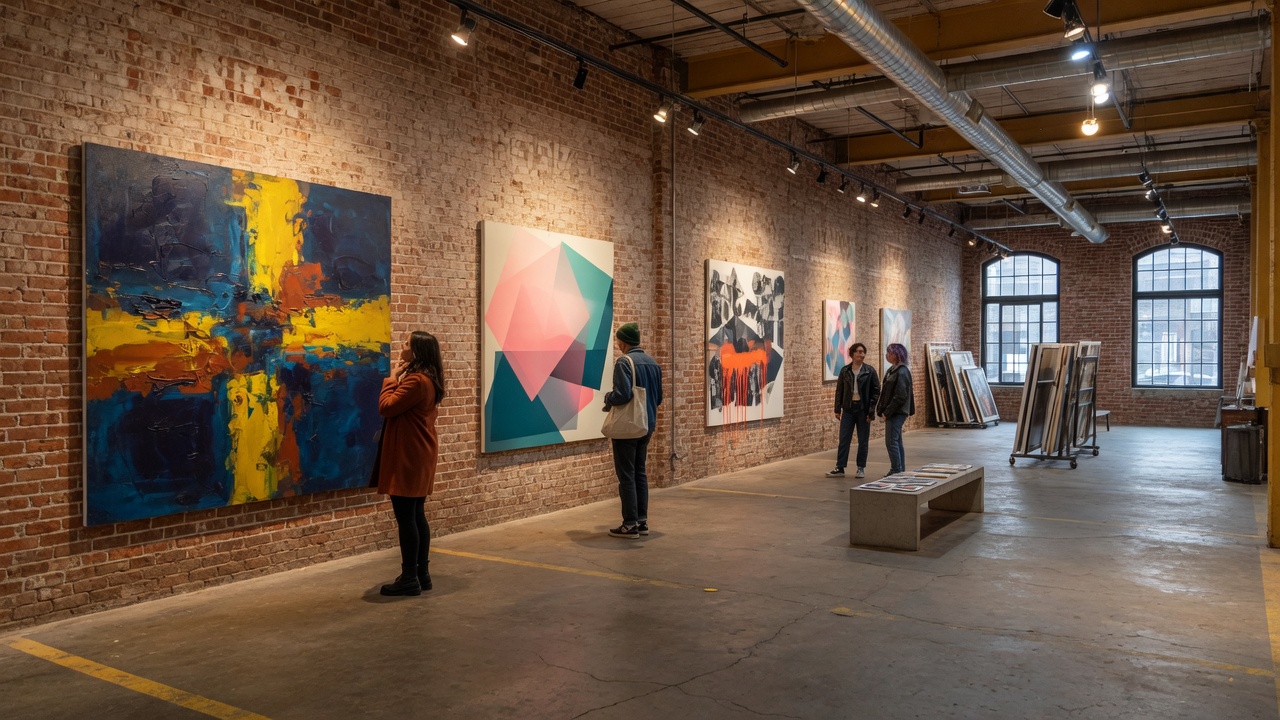
Even before the historic designation, artists were discovering Castleberry Hill. The cheap rents, open floor plans, and industrial character of the warehouse buildings made them ideal studios and living spaces. Musicians, painters, sculptors, and filmmakers began moving into the neighborhood in the 1980s, drawn by the same qualities that had made Castleberry Hill's warehouses obsolete: their size, their openness, and their distance from the mainstream.
The artist migration was organic and grassroots. There was no master plan, no developer incentive, no government program. Artists came because the spaces were available and affordable, and they stayed because the neighborhood felt real. The industrial buildings gave them room to work. The cobblestone streets gave them atmosphere. And the relative isolation from Atlanta's more polished neighborhoods gave them freedom.
The monthly Art Stroll became the neighborhood's signature event — a self-guided gallery walk held on the second Saturday of each month, where studios and galleries opened their doors to visitors. The Art Stroll was never a formal production. It was a community habit — neighbors walking from space to space, meeting artists, looking at work, and talking about the neighborhood. It continues today and remains one of Atlanta's most authentic art events.
Nelson Street emerged as the neighborhood's creative corridor — home to galleries, studios, and cultural spaces that gave Castleberry Hill its artistic identity. The street became synonymous with the neighborhood's creative spirit, and the galleries along Nelson remain a draw for visitors and residents alike.
The Stadium Era and Renewed Interest (2000s–Present)
The opening of Mercedes-Benz Stadium in 2017 — replacing the Georgia Dome on the adjacent site — brought Castleberry Hill into the spotlight in a new way. The stadium is visible from many of the neighborhood's streets, and its presence has changed the area's dynamics. On game days and concert nights, the neighborhood buzzes with foot traffic. The surrounding area has seen new development, improved infrastructure, and increased visibility.
But Castleberry Hill has managed the stadium's influence with more grace than many neighborhoods would. The warehouse buildings — too large, too solid, and too historically significant to demolish — have absorbed the stadium's impact without losing their character. The cobblestone streets still exist. The galleries still open their doors. And the neighborhood's identity, rooted in its architecture and its creative community, has endured.
Today, Castleberry Hill is experiencing a new wave of interest. Buyers and renters — many of them young professionals drawn to the neighborhood's urban character, affordable pricing relative to other intown neighborhoods, and proximity to downtown — are discovering what the artists found decades ago: that these old warehouse buildings, on these cobblestone streets, make for some of the most distinctive living spaces in Atlanta.
Castleberry Hill Today
Castleberry Hill in 2026 is a neighborhood in transition — but a transition that honors its past. The warehouse buildings are being restored and adapted. The galleries are thriving. The Art Stroll continues. And the cobblestone streets, which have survived more than 150 years of Atlanta's relentless reinvention, remain the neighborhood's most powerful symbol.
For potential residents, the history matters. Castleberry Hill isn't a neighborhood that was planned or designed — it was built, abandoned, discovered, and rebuilt by the people who recognized its value. That organic evolution is what gives the neighborhood its soul. The brick walls, the timber beams, the cobblestones — they're not aesthetic choices. They're the residue of real life, and they make Castleberry Hill one of the most genuinely historic neighborhoods in Atlanta.
About the Author

Tommy Williams
Tom Will Sell Atlanta · Intown Atlanta Expert
Tommy is passionate about Atlanta's neighborhood history and the stories that make each community unique. He's helped clients buy and sell homes throughout Castleberry Hill and the west side, and he understands the context behind every block.