
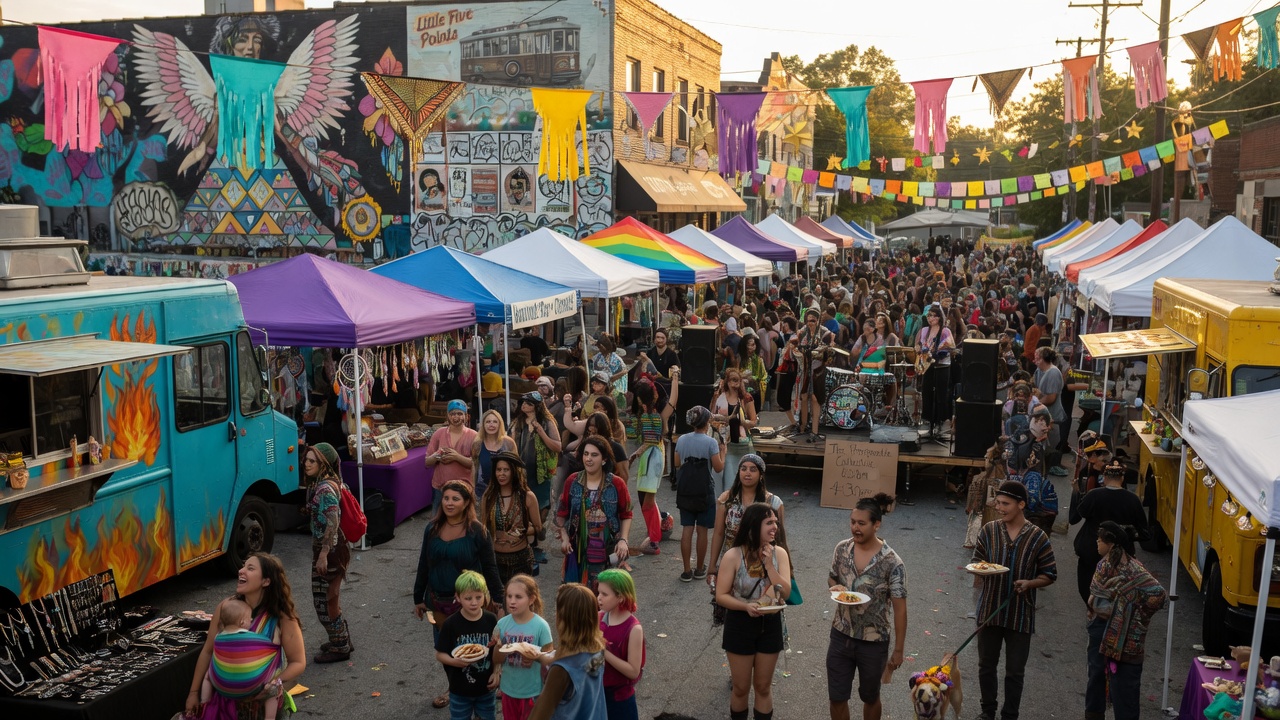
Little Five Points is one of Atlanta's most recognizable neighborhoods, but the story of how it got there — from a quiet streetcar suburb to the city's counterculture capital — is more layered than the vintage shop facades and skull-shaped doorways might suggest. Understanding L5P's history means understanding how Atlanta itself has evolved: waves of growth, decline, reinvention, and the stubborn persistence of communities that refuse to disappear.
The Early Years: A Streetcar Suburb Takes Shape
The area that would become Little Five Points was platted in the late 1880s and early 1900s as part of Atlanta's post-Civil War expansion. The city was growing fast, and developers were carving residential neighborhoods out of former farmland east and south of downtown. The arrival of the Atlanta Railway & Power trolley line — which ran along what is now Ponce de Leon Avenue and connected to the broader streetcar network — made the area accessible to workers and middle-class families.
The homes built during this period — modest Victorian cottages, Craftsman bungalows, and worker's cottages — still define the neighborhood's residential streets. These were not grand homes; they were practical, well-built houses for people who commuted to jobs downtown by trolley. The neighborhood was racially mixed in its early decades, though residential segregation laws would later reshape its demographics.
The name "Little Five Points" refers to the convergence of Euclid Avenue, Moreland Avenue, and McLendon Avenue — a junction of five directions that created a natural commercial node. Small businesses, shops, and services clustered around this intersection, creating a village-like commercial district within the larger city.
Mid-Century Change: Suburbanization and Disinvestment
Like most intown Atlanta neighborhoods, Little Five Points experienced significant change in the decades following World War II. The construction of the interstate highway system — particularly I-20, which cuts through the southern edge of the neighborhood — disrupted established streets and communities. White flight to the suburbs accelerated in the 1960s and 1970s, and with it came disinvestment, declining property values, and rising vacancy.
By the 1970s, L5P had become one of Atlanta's more economically distressed neighborhoods. Commercial vacancies increased, and the intersection of Moreland and Euclid — once a bustling village center — showed visible signs of neglect. The neighborhood's housing stock deteriorated, and crime rates climbed.
But the same qualities that made L5P attractive in the first place — its proximity to downtown, its affordable rents, its walkable layout — also made it attractive to a new generation of residents. Artists, musicians, students, and young people who couldn't afford (or didn't want) the suburbs began moving in during the late 1970s and early 1980s.
The Counterculture Emerges: 1980s and 1990s
The transformation of Little Five Points from a declining neighborhood to Atlanta's counterculture capital happened gradually, then all at once. By the mid-1980s, the commercial district along Moreland Avenue had become a magnet for independent businesses that couldn't find space — or didn't fit in — elsewhere in the city.
The Junkman's Daughter opened in 1986, establishing itself as an alternative clothing and novelty store that defied easy categorization. It was followed by a wave of record stores, vintage shops, tattoo parlors, head shops, and independent cafés that gave the commercial district its distinctive character. These weren't businesses that had been recruited by a development authority — they were organic, grassroots ventures started by people who lived in the neighborhood and wanted to build something that reflected their culture.
The music scene was central to L5P's identity during this period. The neighborhood became a hub for punk, hardcore, indie, and experimental music — a place where bands practiced in basement studios, played in bar back rooms, and distributed flyers for shows at every available venue. The record stores — Criminal Records, Wax 'N' Facts, and others — served as cultural anchors, connecting the neighborhood's music community to the broader world.
The Vortex Bar & Grill opened its original location in 1992 and quickly became the neighborhood's social center. The now-iconic skull-shaped entrance — a massive, sculptural doorway that you literally walk through — became L5P's most recognizable image. The Vortex wasn't just a bar; it was a statement: this neighborhood is different, and it's not apologizing for it.
Stabilization and Growth: 2000s to Today
By the early 2000s, Little Five Points had completed a remarkable arc — from declining neighborhood to one of Atlanta's most culturally significant areas. The commercial district was thriving, the residential streets were stabilizing, and the neighborhood's reputation had spread far beyond Atlanta.
The broader intown Atlanta renaissance of the 2000s and 2010s brought new investment to L5P, though the neighborhood absorbed development differently than some of its neighbors. While Old Fourth Ward and BeltLine-adjacent areas experienced dramatic new construction, L5P's residential streets remained largely intact — the same bungalows and Victorians, many now renovated, lining the same tree-shaded blocks.
The commercial district evolved as well. New restaurants, coffee shops, and bars opened alongside the established vintage stores and record shops. The neighborhood attracted a more diverse dining scene while maintaining the independent, non-chain character that had always defined it. Aurora Coffee became the neighborhood's morning anchor. Restaurants and bars along Moreland Avenue and Euclid Avenue added to the options without displacing the core businesses that gave L5P its identity.
Today, Little Five Points is one of Atlanta's most walkable neighborhoods (Walk Score: 88), with a housing market that reflects both its desirability and its range. The Halloween Festival & Parade draws thousands of visitors each October. The annual Little 5 Fest celebrates the neighborhood's music and arts community. And the intersection of Moreland and Euclid remains one of the most vibrant and visually distinctive public spaces in the city.
The Five Points: Understanding the Geography
The name "Little Five Points" refers to the intersection at the heart of the neighborhood — where Euclid Avenue, Moreland Avenue, and McLendon Avenue converge from five different directions. This junction creates a natural center of gravity for the commercial district, and it's where L5P's identity is most concentrated.
The neighborhood's boundaries are informal but generally understood to extend along Moreland Avenue to the north and south, along Euclid Avenue to the east and west, with the residential streets between these corridors forming the core. To the west, the neighborhood blends into Inman Park. To the northwest, across the railroad tracks, lies Cabbagetown. To the south and east, the residential streets extend into the broader Ponce-Highland area.
This geographic position — at a literal and figurative crossroads — is part of what makes L5P special. It's not isolated; it's connected to everything around it. But it has enough density and distinctiveness to maintain its own identity. You can walk from Inman Park through L5P to Cabbagetown and experience three completely different neighborhood atmospheres in under thirty minutes.
What the History Tells Us About Living Here Today
Little Five Points' history matters for anyone considering living here, because it explains why the neighborhood feels the way it does. The Victorian cottages and Craftsman bungalows aren't nostalgia — they're the actual homes of a working-class streetcar suburb, still occupied and loved a century later. The record stores and vintage shops aren't a theme — they're the continuation of a counterculture tradition that started in the 1980s and never stopped. The festivals aren't marketing events — they're community celebrations that grew organically from a neighborhood that knows how to throw a party.
When you move to Little Five Points, you're not just buying a house or signing a lease. You're joining a neighborhood with one of the deepest and most distinctive histories in Atlanta — a place that has survived disinvestment, reinvention, and every trend that has swept through the city, emerging each time with its identity not just intact but strengthened.
About the Author

Tommy Williams
Tom Will Sell Atlanta · Intown Atlanta Expert
Tommy has watched Little Five Points evolve for years and knows the neighborhood's history as well as its present. If you're considering a move to L5P, he can help you understand not just what the neighborhood is — but why it matters.