
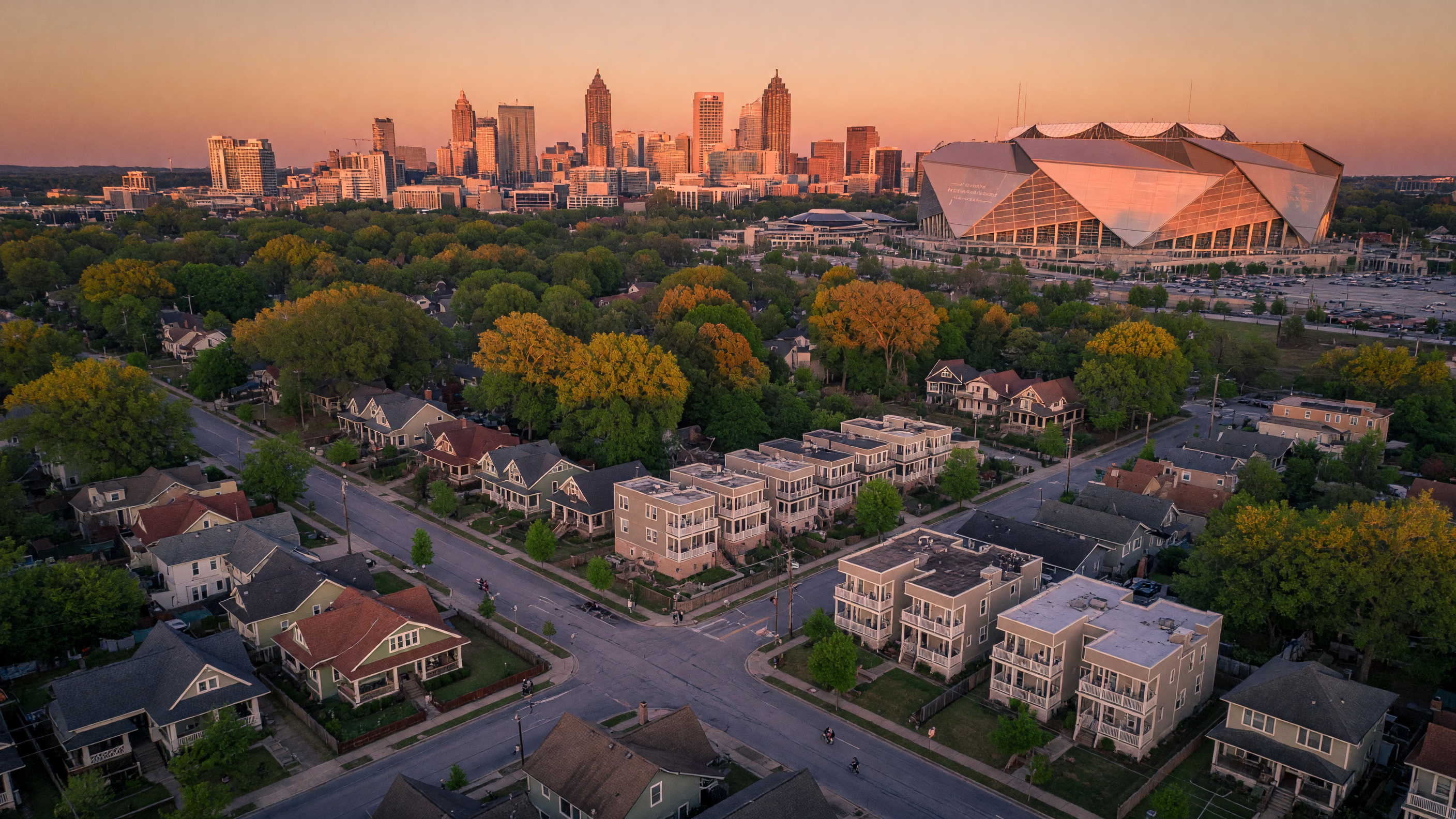
Vine City's history is one of the most important in Atlanta — and in the broader story of Black America. A neighborhood just west of downtown, Vine City became a center of civil rights organizing in the 1950s and 1960s, home to leaders who changed the course of the nation. But Vine City's story begins long before the civil rights era, and understanding its full arc — from early settlement through fire, rebuilding, activism, disinvestment, and renewal — is essential to understanding what the neighborhood is becoming today.
Early Origins: A Neighborhood West of Downtown
Vine City developed in the late 1800s and early 1900s as a residential area on Atlanta's western fringe. The neighborhood grew along streets that are still recognizable today — Vine Street, Walnut Street, Maple Street, and the corridors that would become central to the neighborhood's identity. Like much of Atlanta's west side, Vine City was shaped by the city's geography: a neighborhood of rolling hills, mature trees, and residential streets that felt removed from the commercial energy of downtown despite being only a mile away.
By the early 1900s, Vine City had established itself as a predominantly Black residential neighborhood — a community of homeowners, renters, ministers, teachers, and working families who built homes, churches, and civic organizations. The neighborhood's proximity to the Atlanta University Center — Morehouse, Spelman, Clark Atlanta — gave it a connection to Black intellectual and cultural life that would prove decisive in the decades to come.
The 1917 Great Atlanta Fire
In May 1917, a devastating fire swept through Atlanta's Old Fourth Ward and west side, destroying over 300 acres and leaving more than 3,000 families homeless. The fire — one of the worst urban fires in American history — devastated Vine City and the surrounding neighborhoods, leveling homes, churches, and businesses.
The aftermath of the fire reshaped Vine City. Rebuilding efforts brought new construction to the neighborhood — the Craftsman bungalows and brick homes that define Vine City's housing stock today were largely built in the years following the 1917 fire. The fire also accelerated demographic change in the area, as Black families displaced from the Old Fourth Ward and other burned areas settled in Vine City and the surrounding west side neighborhoods.
The 1917 fire is a defining event in Vine City's history — the catastrophe that cleared the ground for the neighborhood that exists today.
The 1920s–1940s: Building a Community
In the decades following the fire, Vine City grew as a stable, working-class Black neighborhood. Families built homes — Craftsman bungalows, Folk Victorian cottages, and modest brick houses — on the residential streets that radiate from the neighborhood's center. Churches became anchors of community life, and civic organizations provided the structure that sustained the neighborhood through the challenges of the Jim Crow era.
Vine City's churches — including West Hunter Street Baptist Church and Wheat Street Baptist Church (in nearby Sweet Auburn) — were more than places of worship. They were community centers, organizing hubs, and the social infrastructure that held the neighborhood together during decades of segregation and limited public investment.
By the mid-1940s, Vine City was a mature, established Black neighborhood with a stable population, active churches, and a residential character that made it one of the most livable neighborhoods on Atlanta's west side.
The 1950s–1960s: Civil Rights on Sunset Avenue
The most transformative period in Vine City's history began in the 1950s, when the neighborhood became a gathering point for civil rights leaders who would reshape American history.
The catalyst was Sunset Avenue — a quiet residential street in Vine City that became, almost by accident, one of the most significant streets in the civil rights movement. In the 1950s and 1960s, a remarkable concentration of civil rights leaders lived on and near Sunset Avenue:
Martin Luther King Jr. purchased a home at 234 Sunset Avenue in 1964 — a modest 1933 brick bungalow that Coretta Scott King maintained as the family's Atlanta residence. The home, which sits on a tree-lined residential block, is now part of the Martin Luther King Jr. National Historical Park, managed by the National Park Service. It stands as a physical reminder that the movement's most influential leader chose Vine City as his Atlanta home.
Julian Bond, who co-founded the Southern Christian Leadership Conference (SCLC) with Dr. King and other ministers, lived in Vine City. Bond went on to become a Georgia state legislator, a professor, and the chairman of the NAACP — but his roots were in this neighborhood.
Maynard Jackson, who grew up in Vine City, would become Atlanta's first Black mayor in 1973 — the first Black mayor of a major Southern city. Jackson's political career, which also included three terms as mayor, began in the community institutions and civic networks of Vine City and the surrounding west side.
Ralph David Abernathy, Martin Luther King Jr.'s closest associate and co-founder of the SCLC, served as pastor of West Hunter Street Baptist Church in Vine City. Abernathy's church was a center of movement activity — a place where strategy was discussed, speeches were rehearsed, and the organizing work that powered the civil rights era was carried out.
The concentration of these leaders in Vine City was not coincidental. The neighborhood's proximity to the Atlanta University Center, its established Black community institutions, and its residential character made it a natural home for organizers who were building the movement in Atlanta. Sunset Avenue became a street where the most consequential conversations in American civil rights history took place — on front porches, in living rooms, and in the homes of people who believed that the nation could be changed.
The 1970s–1990s: Disinvestment and Resilience
The decades following the civil rights era brought significant challenges to Vine City. Like many Black neighborhoods in Atlanta, Vine City experienced the effects of white flight, suburbanization, and systemic disinvestment. Population declined, property values fell, and some of the neighborhood's homes fell into disrepair.
But Vine City's community institutions held firm. The churches continued to serve the neighborhood. The civic organizations continued to advocate for residents. And the Vine City Neighborhood Association, which had been organizing residents for decades, worked to preserve the neighborhood's housing stock and protect its interests as Atlanta changed around it.
The challenges of this era were real — Vine City faced crime, poverty, and the kind of disinvestment that has hollowed out urban neighborhoods across America. But the neighborhood's community infrastructure — the churches, the neighborhood association, the residents who stayed — kept Vine City intact through decades that could have erased it.
The 2000s–Present: Revitalization and New Chapter
The most recent chapter in Vine City's history has been defined by revitalization — driven by the construction of Mercedes-Benz Stadium, the opening of the Westside BeltLine trail, and the creation of Westside Park, Atlanta's largest park.
Mercedes-Benz Stadium, which opened in 2017, brought national and international attention to Vine City's doorstep. The 71,000-seat venue — home to the Atlanta Falcons and Atlanta United FC — sits at the neighborhood's eastern edge and has generated investment, infrastructure improvements, and visibility that have transformed Vine City's profile.
The Westside BeltLine trail, which runs along Vine City's western edge, connected the neighborhood to Atlanta's growing trail network and catalyzed new development — townhomes, apartments, and mixed-use projects that are filling in underutilized land.
And Westside Park, built around the Bellwood Quarry and the Westside Reservoir, gave Vine City a 280-acre backyard — a massive green space with trails, overlooks, and skyline views that has become one of Atlanta's most popular public spaces.
The result is a neighborhood at an inflection point. Vine City's civil rights history, its proximity to downtown and the stadium, its BeltLine access, and its Westside Park adjacency have made it one of the most strategically located neighborhoods in Atlanta. New construction is transforming the housing stock. New residents are arriving. And the community organizations that have sustained Vine City for decades — including the Vine City Neighborhood Association — are working to ensure that the neighborhood's revitalization honors its past.
For buyers and residents willing to invest in a neighborhood with deep roots and genuine momentum, Vine City offers something rare: the chance to be part of a story that is still being written — a story that began on Sunset Avenue and continues today.
About the Author
Tommy Williams
Tom Will Sell Atlanta · Intown Atlanta Expert
Tommy has deep knowledge of Vine City's history and its housing market. Whether you're drawn to the neighborhood's civil rights legacy or its revitalization story, he can help you navigate the unique dynamics of buying or selling in Vine City.